July ‘26 Round 2 | Dishonorable Mentions and Changes On that Far Meridian

Thanks for Reading!

Any support, even just giving these posts a read, is always appreciated.

Still want to grab my book BEYOND THE RUINED NIGHTS?

Get the Ebook here: Amazon

Get Paperback and Hardback here: Bookshop.org 

Recent Updates:

My summer events are set! 

July 25th @  The Author Shoppe in Hattiesburg, MS

July 26th @ Magnolia TCG Exchange in Pearl, MS

September 5th @ Pearl Public Library in Pearl, MS. 

To stay up to date, follow me on Facebook.

Project Progress

I have finished my short story draft, gotten editor comments on my Horror Novella completed, and gotten final reader feedback. 

I’m working on addressing some internal edit notes for Book 2 of Calarine, then I’ll be prepping that Horror Novella for publication. Stay tuned!
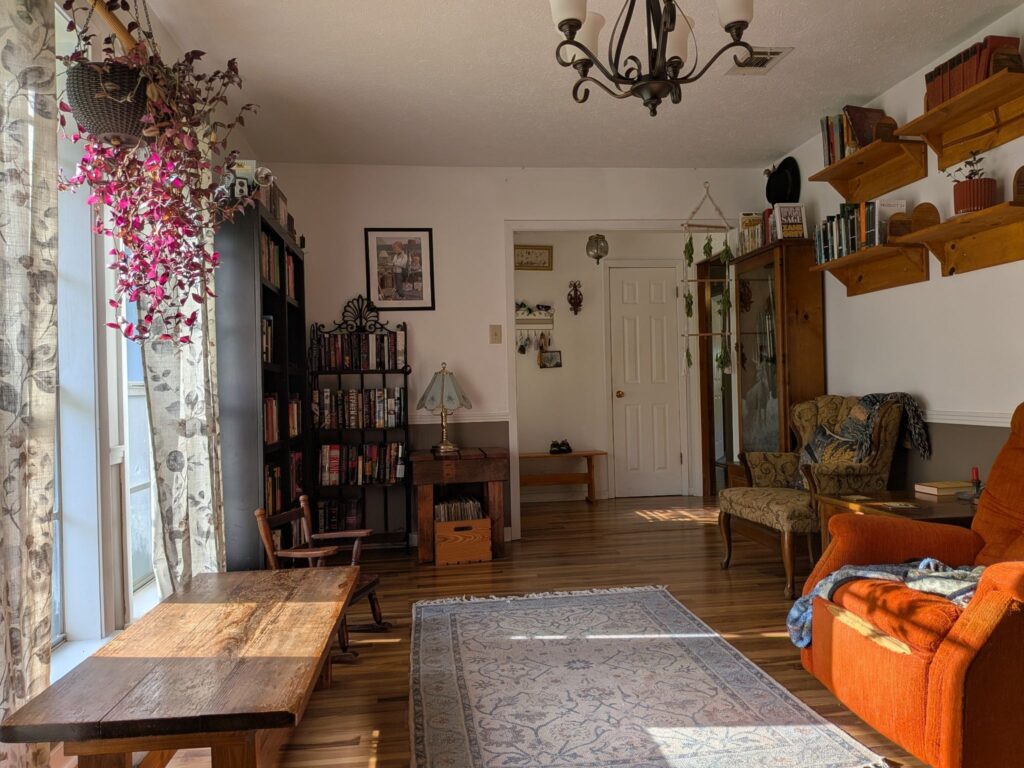
My home library, the sun casting blocky shadows in the late afternoon. Photo by the author. 

Recent Fascinations | The Fiction Books that Made Me, Dishonorable Mentions + Stages and Changes, a Goodbye to Fiction and Fascinations

Want to understand what this series is? Go Here 

I almost didn’t write this for a couple different reasons. The first is that I struggled with whether or not it is productive to add negativity onto the tail end of this series. The second is that, frankly, I’m tired of writing this damn newsletter. 

We’ll get to that second point later (the Stages and Changes section of this particular newsletter edition), but as far as the first one goes, I decided to go on with it because I’ve already planned it and mentioned it a half-dozen times in the other entries. 

So, without further hemming and with no hawing to be tolerated, let’s just get into it. 

The Fiction Books that Made Me: Dishonorable Mentions. 

First, in true pretentious fashion, let’s define some terms. What do I mean by Dishonorable Mention?

For me, the term means that these three entries are stories, and in two cases series, that I know have affected me as both a reader and a writer, but for one reason or another I feel uncomfortable praising them at any length. For two of them, it is because of the behavior of their respective writers, for one of them it is because I feel a kind of silly shame for ever even having liked it. So, let’s walk these skeletons out of the closet and get on with the thing. 

AMERICAN GODS | Neil Gaiman

The difficult thing to parse about this particular novel is that, had I made this list a few years ago, AMERICAN GODS would have rested firmly at #2. It is a novel that is immensely important to me and my view of the United States. It shaped my understanding of story and plot and character as a young man who was just starting to take writing seriously.

I will never forget the first time I read the book. 2017, on a plane from Jackson, Mississippi to Boston, Massachusetts. I finished the novel just as we landed and got off the plane in Boston on the weekend of the 4th. It was enormously impactful and an experience that changed my life. When I got back home, I changed my major to History and started taking my education seriously for the first time in my life.

Over the next several years, I began to fanatically follow Gaiman’s work, and for a brief period, he usurped King as my favorite writer. 

And then, in 2025, the VULTURE article hit me like a Mack truck. I won’t go into the contents of that article, but it was a harrowing read and I have had to reevaluate my relationship to Gaiman and his work. Perhaps there will come a time when my personal distance from being a young writer who idolized Gaiman not just as a writer but as a person will be great enough that I can reevaluate my relationship to his art. AMERICAN GODS still changed my life, but at this time, I struggle to know if that is a good thing or a bad one. 

THE HARRY POTTER SERIES | J.K. Rowling

If there’s ever been a writer who needed to learn to shut the fuck up, its JKR. I am one of the millennials where my childhood was consumed by all things Harry Potter. I know my house, my patrounos, and my familiar (Gryffindor, Badger, Rat), and so do all of my friends. I read the books in middle school, watched the movies, and lived and breathed the fandom in those early internet days. 

As I got into college, I defended the series (and JKR) against the constant conservative backlash as she expanded the world and added to characters, including sidestepping Dumbledore into being LGBT representation. 

Imagine my whiplash, and the whiplash of many a HP fan, that into the 2020s we found ourselves backpeddling as JKR took an atmospheric nosedive that eventually ended up in HOLOCAUST DENIAL. 

My relationship with this series is decidedly less complicated than my relationship with Gaiman and his work. At this point, I have moved on. I enjoy the books and the movies on occasion, and I try to ignore whatever fuckin’ nonsense that ridiculous woman is saying. Still, when I turn to my inner world as a writer and imagine a holiday setting, snow covering a fantasy world, I imagine Hogwarts. And I likely always will. 

THE LEFT BEHIND SERIES | Tim LaHaye and Jerry B. Jenkins

…Okay let me explain. 

This series is utter dogshit. It is poorly written chaff that makes little sense and was written with the explicit purpose of converting people to a particularly American brand of Christianity using a fear of eternal suffering and being “left behind” following the Rapture. The authors are two hacks with questionable morals and unquestionably shitty ideas about the world. 

BUT 

When you’re 15 years old in South Mississippi and a Certified Heathen who didn’t grow up religious, it is a pretty wild ride. Demons and angels, and people getting punched to death and a hooker who MIGHT JUST TEMPT THESE GOOD CHRISTIANS INTO SINNIN’.  So, cut me a break. 

Yeah, the books are a shitheap. I’ve never reread them, but they DID serve as a pathway to better postapocalypse fiction for me, and for that I am forever grateful. 

You won’t catch me admitting it in public, though. 

Some Final Notes on the Dishonorable Mentions

Don’t take any of the discussion of these three entries too seriously. 

If you still love Gaiman’s work, then by all means continue reading and enjoying it. Far be it of me as a Hemingway and John Wayne lover to tell anyone not to read a book because the writer is a dirtbag and a bastard. If you still love HARRY POTTER, the same applies. If you love THE LEFT BEHIND…okay you might need some help but that’s okay, we all hit rock bottom at some point. 

Anyway, I’m going to move on to what this edition of my newsletter is really about. I’ll see y’all on the other side. 

Stages and Changes, a Goodbye to Fiction and Fascinations

I started this newsletter back in December of 2022. From the very beginning it has had a nearly identical structure to it. I lay out some recent updates and project progress, and then I write for maybe 500 words on a “Recent Fascination”. Early on, that was things I was reading and how they tied into my writing projects. Later, it became more personal and self-exploratory. But throughout all of it, the structure has remained largely the same. It’s fascinating to go back and see my previous writing processes laid out, like my claims that I’m a discovery writer in that first issue, and to track the progression of my attempt at being a bookish influencer right up until the point I abandoned it. 

What is less enjoyable though, is how it becomes obvious throughout each edition that I, at some point, lost interest in the newsletter. I started phoning those “Recent Fascinations” sections in. Some of them are shockingly short, less than 300 words. Some are banal and useless. Some are meandering and meaningless. Some are all three!

It’s obvious to anyone that the monthly update newsletter has become something of an obligation, and at this point it’s one I see very little point in. Most months, I don’t have any significant updates on my work or story publications, and most months the “Recent Fascinations” section becomes an after thought. 

Take in comparison my recent essay “A Brief Interlude on Stepping Away”. The writing process for that essay was a joy. It came quickly and easily, and the end product feels real. I had people from my personal life reach out and say they enjoyed it. I have gotten more views here on it than anywhere else. It felt like something real. After publishing it, I started exploring the personal essay scene on Substack. I started reading them, participating in the community, and I’ve found something genuinely enjoyable. A text-based version of the YouTube video essay I’ve been loving for years.

And, I think, I’ve found what I want my newsletter to be. 

While it might feel sudden on the outside, this will be the last monthly edition of my “Fiction and Fascinations” newsletter. Over the coming month I’m going to start implementing a number of changes.

To lay them out as I currently have them planned:

  • I will be renaming the newsletter into something completely different, and to be determined. 
  • The newsletter’s primary focus will be shifting to a personal essay-first approach, with updates on writing happening as asides.
    • Note: information about book releases and new short stories will still be sent out here regularly as relevant. 
  • Newsletter releases will be more infrequent/unscheduled. Instead of aiming for the first week of the month, I’m going to aim for two essays a month, but should it make sense for me to skip a month entirely, I will. The focus will be on the essays not on obligatory updates. 
  • These essays will NOT focus specifically on my writing process or on my influences, as Fiction and Fascinations have. Instead, they will just be personal essays on topics that interest me.
    • Examples:
      • Third spaces
      • Death and funeral culture
      • The history of my home town
  • I’m going to start creating digital zines that I will be sharing exclusively through substack and this newsletter. 
  • My website will become an archive of old newsletters, but new releases will not regularly be posted there. This will be the final simultaneous post. 
  • NOTHING will change about how you get the emails. Don’t worry about any of this impacting you receiving my updates!
    • However, if you want to participate in discussions and other pieces of it, create a free Substack account and follow me! It’s the newsletter delivery service I use, and by having a native account you’ll have access to comment features. 

These changes probably sound insubstantial, but I am confident that by turning this into a space for creative nonfiction and personal essays, the entire vibe will change. 

I guess we’ll have to see. 

As always and forever:

Thanks for reading. 
July ‘26 | To Kill a Mockingbird

Thanks for Reading!

Any support, even just giving these posts a read, is always appreciated.

Still want to grab my book BEYOND THE RUINED NIGHTS?

Get the Ebook here: Campfire 

Get Paperback and Hardback here: Bookshop.org 

Recent Updates:

My summer events are set! 

July 25th @  The Author Shoppe in Hattiesburg, MS

July 26th @ Magnolia TCG Exchange in Pearl, MS

September 5th @ Pearl Public Library in Pearl, MS. 

To stay up to date, follow me on Facebook.

Project Progress:

I am still working on finishing up this short story draft, after which I will shift over to working on prepping the final read version of my horror novella. All other projects are currently on hold until I get these two hammered out. 

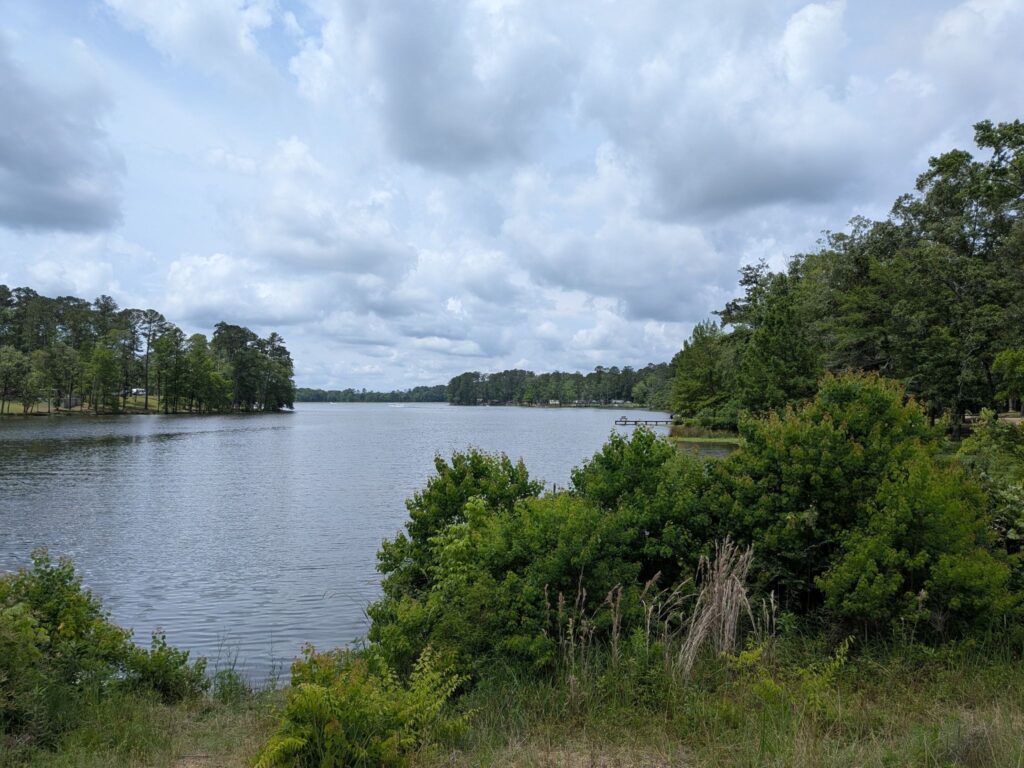
Shadow Lake at Roosevelt State Park, photo by Author. 

Recent Fascinations | The Fiction Books that Made Me #1: TO KILL A MOCKINGBIRD by Harper Lee

Want to understand what this series is? Go Here 

“The one thing that doesn’t abide by majority rule is a person’s conscience.” 

And here we come to the end of the long road, to the story that I have, in a lot of ways, dreaded writing about. There is something in talking about my favorite novel, my favorite story, that fills me with a kind of thin anxiety. As I have prepared to write this, I have struggled with a series of questions cycling in my mind. 

“Can I do it justice?” 

“Am I qualified to even talk about it?”

 “What more can I say about a story that’s been talked about so much?”

Now that I’m finally here, sitting down to write out my thoughts about a story that means so much to me, I am afraid I don’t have any answers to those questions. I am not going to try and do it justice, I’m not going to try to lean on some ambiguous definition of qualification, and I am not going to try and find new things to say about this story. Any work of analysis on a book as important as TO KILL A MOCKINGBIRD is going to be derivative in one way or another. So, I’m not going to try and offer analysis, but instead I’m going to stick to my original purpose for this series of essays. I’m going to explain what this story means to me as a reader and a writer. 

Maybe, if I do my job here, I’ll find something more to say as well. 

TO KILL A MOCKINGBIRD as It Lives in My Heart

To tell the story simply, I was not a good student as a high schooler. 

That might be underselling it a bit, and I’m sure any of my high school teachers reading this would scoff to themselves, maybe even remarking that a more obvious statement could not have been made. I can’t give a reason for why I didn’t put any real effort in during those years. I’ve attempted to make excuses over the years, but they don’t feel earnest anymore. There is no real reason besides laziness or a lack of respect, two things that I have, mostly, grown out of. 

That lack of dedication, though, has to be my framework here, because it makes the start of my relationship with Harper Lee’s TO KILL A MOCKINGBIRD all the more important. I had a lot of great teachers during my time at my little podunk high school, but one thing I would criticize them all for was the decision (which was popular at struggling districts in Mississippi at the time) to often eschew reading in favor of watching. We rarely read books in the major English courses, and instead we watched adaptations of them in one form or another. I experienced THE OUTSIDERS, BEOWULF, and ROMEO AND JULIET all through this lens. 

Which makes my 11th grade English teacher’s decision to have us read Mockingbird all the more important. There is a gravitas to a book being a reader’s favorite, but that feeling of insurmountable importance is only magnified if it’s a book they read when they were 16 years old. At the time, my scope of personal experience was deeply narrow. I grew up in a town deep within rural Mississippi so small it barely even registers as a town. There is a lot of that upbringing I will forever be grateful for, but my narrow horizons as a young man is not one of them. I was prejudiced, spiteful, insular. I was a great many things then I try not to be now. 

For anyone who has grown up in that kind of environment, with that kind of experience, there is often a single moment that begins the long process of shifting their perspective. For me, even if I didn’t realize it at the time, TO KILL A MOCKINGBIRD is that moment. It is hard now, 15 years divorced from the person I was at 16, to find exactly what it was in the book that caused me to turn a critical eye to my view of the world. When I do look back on what struck me so much about that book then, what comes to mind is interesting. I don’t think most of the racial tensions present in every page, or of Boo Radley and his representation of how small towns so easily cast away those that are different. Instead, what stands tallest in my mind is Atticus Finch himself.  

More specifically, I guess, what struck me was the way Scout sees her father, which really could be summed up as the entire damn point of the book. Atticus Finch is a mountain of a man, so counter to the depictions of masculinity I had grown up exposed to in John Wayne and his contemporaries. Finch is the ideal father, stern and no nonsense while parenting with a kind of casual grace. He is the ideal Southern man, stoic and strong with an uncompromising sense of morals. Beneath both of these facets of his personality, though, is a softness. He is gentle and understanding to those around him. He moves through the world with an endless supply of grace and patience. He forgives immediately, holding no grudges or judgements against those around him. He loves his children and his community with a brazen forwardness that, at times, feels transgressive. 

When Scout remarks on one character’s unexpected niceness, Atticus responds “Most people are, Scout, when you finally see them.” 

When I read this book, I had already begun to develop an uncompromising, cynical view of the world that would become the defining feature of my young adulthood. People beyond me and my loved ones were dolts, unworthy of grace or forgiveness. The world was a bleak place that served as an obstacle between me and my own goals, and as such I should respond only to the challenges it offered me with hostility. Unfortunately, my exposure to TO KILL A MOCKINGBIRD did not correct this course entirely. Atticus Finch’s gentle masculinity did not inoculate me to the bigotry and cynicism that characterized my late teens and early 20s. What it did do, though, is plant a seed. Throughout everything, I still upheld Finch as the ideal man, the perfect father, even if I failed to see how I was not living up to those ideals. 

This is not the point where I tell you that I have begun to live up to my idealized version of Atticus Finch, either. I certainly try, but I’m imperfect as any person. Quick to anger, too eager to hate. I’m still working to be a better person, but now I think that the real lesson of TO KILL A MOCKINGBIRD for me has become something a little different than just an ideal to strive for. As I continue to step into my 30s, I instead keep thinking back to Atticus and his declaration that most people are good. I hope to find the time to better love my neighbor, to view the world less with cynicism and expectations of the worst, but instead with grace and kindness, even for those who seem like they deserve none. 

TO KILL A MOCKINBIRD as it Lives in My Mind

After all of that, it is hard to transition to this. My relationship with TO KILL A MOCKINGBIRD as a reader is as a person engaging with a literary work that touched me during a foundational moment in my life. My engagement with it as a writer is decidedly different. You might think that as my favorite novel, as the fiction book at the top of my list of books that influenced me the most, this book must have had an enormous impact on my work. That is not really the case. 

To explain what I mean, I need to make clear exactly how I regard TO KILL A MOCKINGBIRD as a writer. 

In 1960 when Harper Lee published TO KILL A MOCKINGBIRD, she published a perfect novel. I mean that as literally as you can take it. There is no word out of place, no scene that feels sluggish or mechanically unsound. There is no edit or change or tweak that could improve the story without harming its greater whole. The thematic depth is endless, the clarity at which it is delivered is astounding. Lee’s novel is, under any metric worth using, literally flawless. While not stylistically divergent in any significant way, TO KILL A MOCKINGBIRD stands shoulder to shoulder with prominent art novels like THE SOUND AND THE FURY and BLOOD MERIDIAN. While an individual reader might not be struck by it in the same way I have been, that is a matter of taste and preference and not a reflection of its flawless nature. It is a novel without any mechanical or artistic impurities, a generational work of art that could never have been replicated. So perfect, in fact, that Lee never published another novel in her lifetime (GO SET A WATCHMAN is a topic for another day). She got it right the first time, and never attempted to dip back into that same well again. 

It is that perfection, though, that causes me to set my appreciation for the novel aside when I am writing. Despite my love for it, I do not possess the naivete to think that I am the kind of writer who should attempt to go to that well in Lee’s stead. As I said, TO KILL A MOCKINGBIRD is a perfect work of literary art. 

And I am not a literary fiction writer. 

I am by every measure a decidedly commercial writer. While yes, I do try and create a work of art with each of my stories, I am not writing from the standpoint of creating some perfect tapestry of artistic expression. Instead, I am attempting to tell a story, hopefully well, that might entice people to read my work. I do, like every writer, take pieces of the stories that inspire me and weave them into my work, but I can say that I do not do that with TO KILL A MOCKINGBIRD, at least not consciously. While there may be some stylistic flourish or some thematic parallelism between Mockingbird and some of my work, it isn’t there on purpose should it exist at all. My relationship with the book as a reader is one of love and thankfulness. My relationship with the book as a writer is one of distant respect and admiration. I know that it lies so far beyond my own work that it is best to set it aside and not try and go to whatever mythical well of genius Lee found herself tapped into during her writing years. 

As a writer, it is often just as important to know when to set a work aside, pulling joy from it, but not inspiration. 

Still though, on my darkest days when I feel the most imbittered, the most frustrated with the world, it will always be Lee’s words that ring the truest to me. It will always be Atticus Finch that I go back to, that I try to find some wisdom in. 

I just hope that one day I might finally see the world with the grace that he could offer. 

Thanks for reading. 

May ‘26 | For Whom the Bell Tolls

Thanks for Reading!

Any support, even just giving these posts a read, is always appreciated.

Still want to grab my book BEYOND THE RUINED NIGHTS?

Get the Ebook here: Campfire 

Get Paperback and Hardback here: Bookshop.org 

Recent Updates:

My events for the Spring are DONE. I’ll be working to schedule Summer events this month. 

To stay up to date, follow me on Facebook.

Project Progress:

I am DONE with the initial read and comment of SOC book 2! 

Now I am working on prepping HUM to go to the editor before I keep rolling on book 2. 

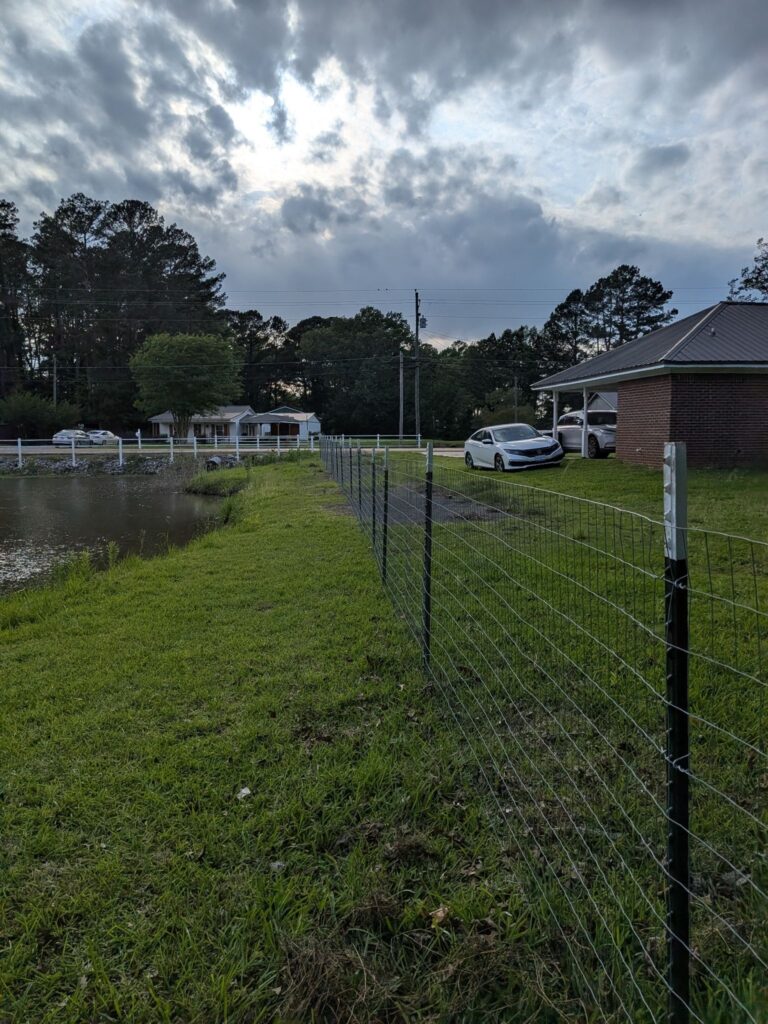
A wire fence running along a pond’s edge in a residential neighborhood. Photo by the Author.

I said in the last post that the four final posts in this series are arguing for a kind of perfection. For some folks, there is perhaps no book of the four that this argument will be more difficult to swallow than Hemingway’s For Whom the Bell Tolls. Hemingway is, and always has been, a controversial figure. His image was, and in some ways still is, that of brutal, absolutist masculinity. Of a womanizing, gun toting, lion killing man who drinks too much and smokes too much and gives too little consideration to those around him. 

This is not just the invention of modern, chronically offended sensibilities. Even during Hemingway’s own lifetime, he carried with him an air of controversy. He was notoriously brusk and ostentatious. He truly did kill a great many exotic game animals. He undoubtedly did drink too much and talk too loud. He also, for what it’s worth, struggled deeply and publicly with his mental health, a fight that eventually resulted in him taking his own life. 

What I’m not going to do in this entry, though, is litigate Hemingway’s public perception. Either you like him or you don’t. I have no horse in that particular race. Instead, I want to USE this perception of Hemingway the Man to look at his writing and explore why it, and in particular For Whom the Bell Tolls is so important to me. 

Despite what perceptions there might be about his public reputation, it is impossible to deny the tenderness and love present on the pages of For Whom the Bell Tolls. It is a war novel, yes, but it is also a romance novel by every true definition of the term. Robert Jordan’s love for Maria is explored in exhaustive detail in the book. And while, yes, the reader only gets to see Jordan’s point of view of this romance, it is one of tenderness, of absolute love, and of respect for Maria as a fellow antifascist. 

On the pages of For Whom the Bell Tolls, perhaps more than in any other book I’ve encountered, the public perception of the other conflicts with what is written on the page. As an undergrad student, my creative writing professor led a class discussion of Hemingway one day, during which he remarked “How Hemingway could be the man he was and still write about love and women so tenderly is the great lesson he has to offer writers,” and I cannot think of a sentiment that sums up what I am trying to explain more concisely. 

What Hemingway has to teach us as both readers and writers is that who we ARE has very little to do with what our art is. For Whom the Bell Tolls is so perfect to me because it encapsulates what the root of my worldview has become through the years. 

Yes, the world Robert Jordan finds himself in is horrible and broken. Fascists are everywhere. Good men are being killed for bad reasons. Justice and peace and freedom, it seems, may have been a lie all along. But still, there are beautiful mountains, swift rivers, and soft, dew filled mornings. And more than anything, more important than the air in our lungs, there is love. “The world is a fine place and worth fighting for,” Hemingway wrote, “and I very much hate to leave it.”

Might we all find such a simple peace in our darkest moments, and might we find a love as pure as one bound to a war torn world. 

Thanks for reading. 

April ’26 |The Stand

Thanks for Reading!

Any support, even just giving these posts a read, is always appreciated.

Still want to grab my book BEYOND THE RUINED NIGHTS?

Get the Ebook here: Campfire 

Get Paperback and Hardback here: Bookshop.org 

Recent Updates: 

I have one signing left for the Spring, this one at Sumrall Public Library in Sumrall, Mississippi, on April 25th. After that, I’ll be planning and scheduling my Summer events. To stay up to date, follow me on Facebook.

Project Progress:

I’ve gotten all of my beta feedback for HUM, and am going to start going through those edits once I finish the first round of editing on Book 2 of Calarine. 

Speaking of, I’m about 70% through this initial round of edits of Book 2. Steady progress!

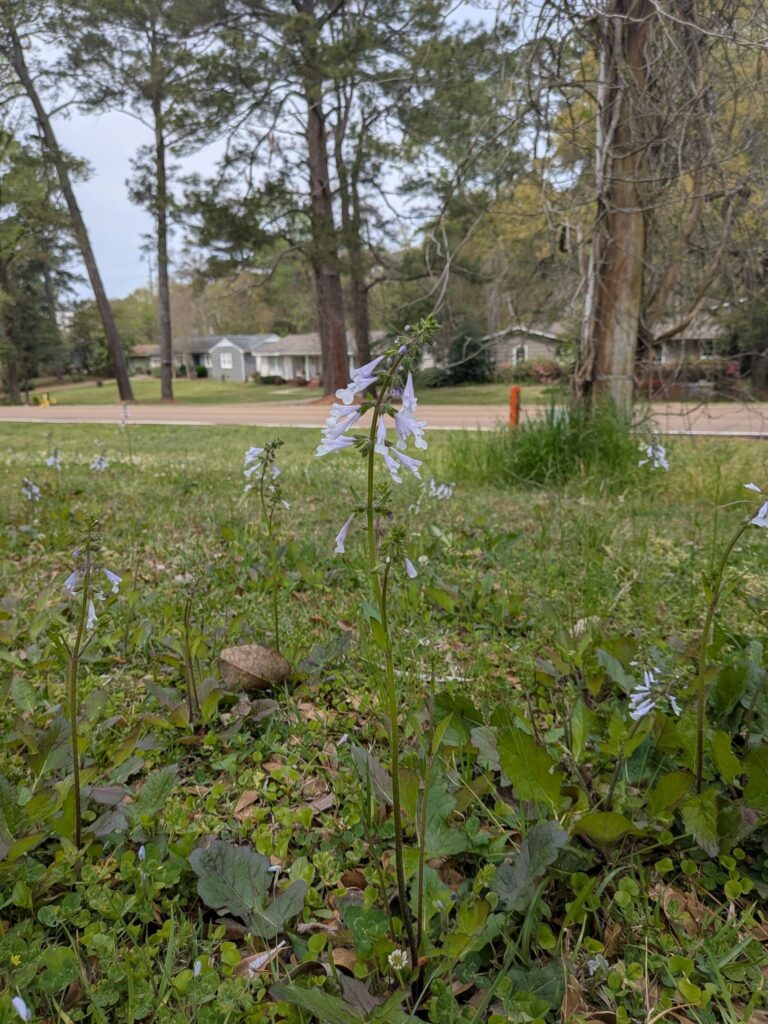
A wildflower along the sidewalk in Jackson, Mississippi. Photo by the Author. 

Recent Fascinations | The Fiction Books that Made Me #4: The Stand by Stephen King

Want to understand what this series is? Go Here 

“No one can tell what goes on in between the person you were and the person you become.”

It is at this point we have entered the realm of the uncontested. From this point forward, meaning this post and the three to follow it, I am no longer just arguing for a book’s influence on myself, but for a status of literal perfection. These four books, to me, are all absolutely perfect. There is, also, a connective theme across all of them both as books and their influence on me as a writer, which we’ll see as we walk through them. It is fitting, then, that we begin this run of books with not only another novel from Stephen King, but perhaps the most controversial of these four books I could give the “perfect” label to. 

THE STAND, especially the Unabridged and Uncut edition, is infamously long. There are, of course, a fair number of people who would say it is TOO long. They are, I’m sorry to tell them, wrong. 

The length of THE STAND is both what makes it a perfect novel to me AND what led to it having such a strangle hold over me as a writer. I fell in love with the characters of the story immediately. I don’t care that it’s 1200 pages long, and I often wish it was 1200 pages longer. Those characters live and breathe in a way that I have seldom seen in other books (except the books ahead of it on this list). Without the book’s length, the characters, and in turn the entire story, would not have the time to settle so deep into the reader’s bones. For the people whom the book works with, it works BECAUSE of its length. 

As a writer, though, it wasn’t the characters that so deeply pulled me into THE STAND, but the way that they interacted with the story. The characters in THE STAND make bad decisions. They are selfish and foolish and idiotic and sometimes all three. Still, though, they remain fundamentally human, real, and relatable. Even the most broken of the villains (Oh Trashcan Man, can you hear him, yes you can), is a character with a reality that surrounds him all his own. When I first read this book in 2020, I was in the middle of grad school and taking a break from writing long-form fiction. A year later, though, when I started the project that eventually became BEYOND THE RUINED NIGHTS, THE STAND hung effervescent in my mind. More than once when working through a foolish decision from one of my characters, I was reminded of the essential craft lesson of THE STAND. 

Sometimes, despite our better efforts, people are stupid. 

That isn’t meant to be some revelatory statement, to be clear. It is very obvious, more so everyday, that people are often very stupid. However, many writers, myself included, often veer toward making our characters, our protagonists, hyper-competent. As part of this, we often get stuck in a loop of trying to find the BEST way for a character to resolve a conflict, instead of the most realistic. And, sometimes, the most realistic result is for even our best characters to fuck up and make a mess of the entire situation. 

And sometimes, if we are especially lucky, those messes make our stories even more interesting. 

Thanks for reading. 

March ’26 | The Sound and the Fury

Thanks for Reading!

Any support, even just giving these posts a read, is always appreciated.

Recent Updates: 

I have several signings coming up between now and April. If you’re local and want to come out, be sure to check out my Facebook for updates.  

Last month, I released a new short story titled “Degeneration”, and you can read it here. 

Still want to grab my book BEYOND THE RUINED NIGHTS?

Get the Ebook here: Campfire 

Get Paperback and Hardback here: Bookshop.org 

Project Progress:

Still waiting on Beta Feedback for my Horror Novella. Will keep you updated on its progress, but I’ve set a tentative goal of having it out by October of this year. We’ll see how that goes. 

I am about 20% through the first round of edits for book 2 of Song of Calarine. Slow but steady.

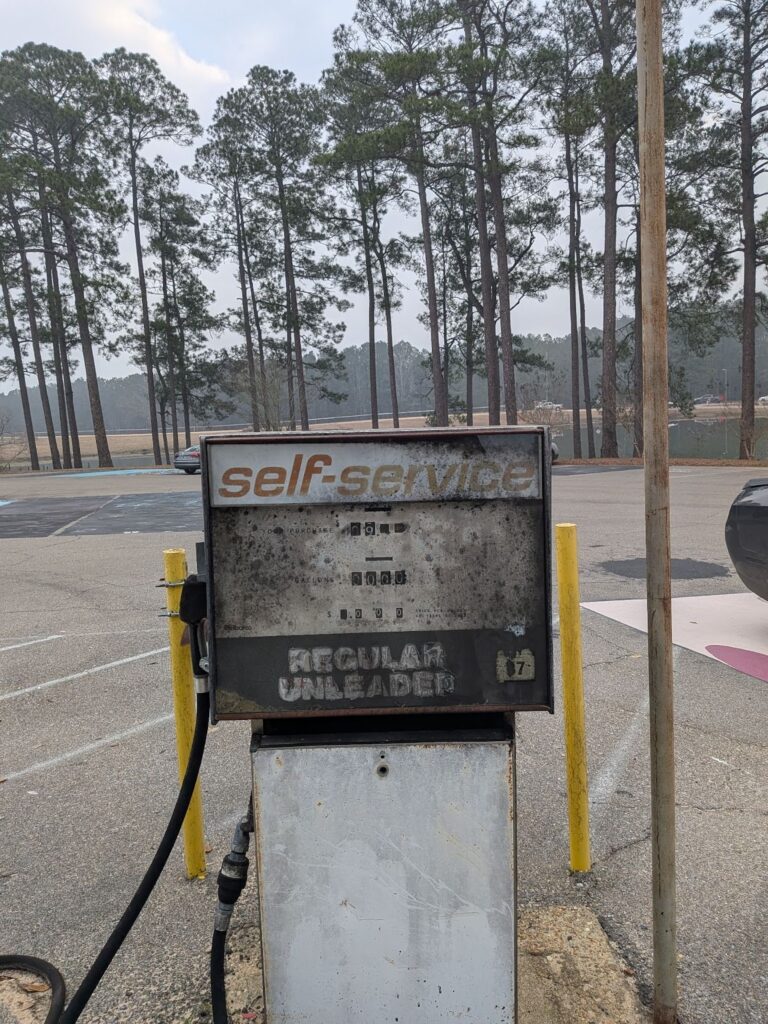
Photograph of the bus fuel pump at historic Forrest County Agricultural High School. Photo By Author 

Recent Fascinations | The Fiction Books that Made Me #5: The Sound and the Fury by William Faulkner

Want to understand what this series is? Go Here 

“Some days in late August at home are like this, the air thin and eager like this, with something in it sad and nostalgic and familiar…”

This is a difficult book to talk about, in no small part because of the way I have structured the previous entries in this series. 

I can’t in good conscience claim that Faulkner has inspired any real piece of my writing. Sure, just as any Mississippian trying their hand at fiction, his textured discussion of our state carries some degree of inspiration for me, but there are a couple of people (Hi, Ethan), who would rightfully call me a liar if I claimed my writing was meant to be Faulknerian. 

That hasn’t always been the case. Like any Mississippi writer with too much education, I did at one point try to copy Faulkner’s style. The original version of my story “Father, or the Pain that Lingers” was written nonchronologically and with a little too much heavy handed stream of consciousness. Some of that remained, like the date stamps and one character’s unravelling point of view, but by the time I edited that story and it was accepted into a litmag, it had turned into something more my own. 

Despite all of this, THE SOUND AND THE FURY  is still one of my favorite novels, and I often find myself thinking on it more and more when working on characters for any of my stories. Faulkner’s characters breathe and behave like real people filled with flaws and trauma, and I have at times attempted to bring some of that same feeling into my own writing, though I will admit such attempts have come with varying levels of success. 

As writers, there is a lot for all of us to learn in the books we read, even the ones we don’t pull from whole cloth. There is perhaps even more to learn in the ones we really don’t pull from at all. While I don’t consider myself to be a Faulknerian writer, and in fact actively try to avoid some of those tendencies in my more genre-focused works, I do find his work to be important to me on several levels. 

What Faulkner does better than anyone else is depict the real world as humans emotionally experience it. Faulkner’s worlds are not realistic in the purest sense. They are filled with melodrama and plot contrivances, but what makes his work so important is the way his characters interact with the world around them feels painfully real. Quintin Compson is perhaps the quintessential example of this. He is depressed and despondent over being sent to a “yankee school.” He pines for his cousin. He aches for a South that never really was. He, perhaps more than anything, shrinks under the shadow of all the Compsons who came before him. Taken quote for quote, Quintin feels ridiculous in a kind of soap opera way, but when taken in context of the world found in THE SOUND AND THE FURY, how else could he have turned out?

The quote most often recited from Faulkner is “To understand the world, you must first understand Mississippi.” Often, it’s used to try and center Mississippi on the global stage or make our humble little state’s importance seem somehow broader and grander than it is. It seems to me, though, that just as valid a reading of that quotes comes from Faulkner’s own writings. That in order to understand the beyond, we must understand the within. 

How could Quintin ever be anything but a Compson?

In the same vein, how could I ever be anything but a Mississippian. 

Thanks for reading.

February ‘26 | THE OLD MAN AND THE SEA

Thanks for Reading!

Any support, even just giving these posts a read, is always appreciated.

Recent Updates:

I’m currently planning my Spring 2026 signings. Stay posted for updates!

Still want to grab my book BEYOND THE RUINED NIGHTS?

Get the Ebook here: Campfire 

Get Paperback and Hardback here: Bookshop.org 

Project Progress:

DONE with pre-beta editing for my horror novella. I’m waiting on feedback from my readers now. 

Currently doing some beta reading for a friend in the meantime. After that, I’ll be starting on a new project so far undecided. 

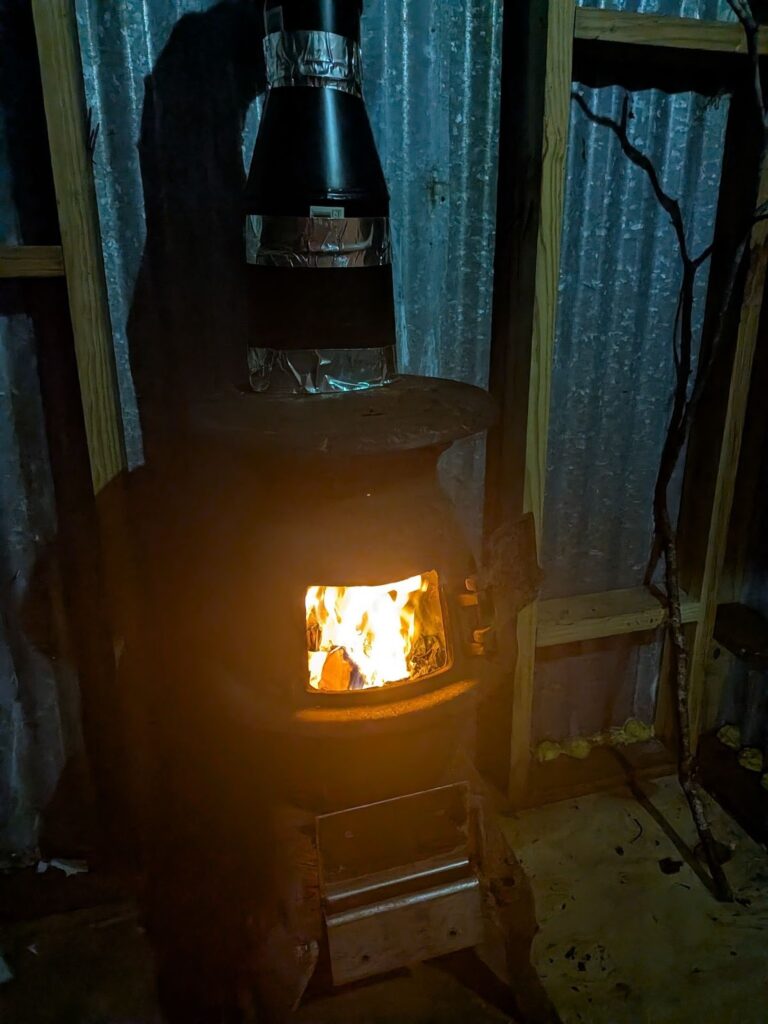
Photo of a wood stove in a remote hunting cabin; Yazoo County, Mississippi. 

Recent Fascinations | The Fiction Books that Made Me #6: THE OLD MAN AND THE SEA

Want to understand what this series is? Go Here 

“My big fish must be somewhere.”

Talking about this particular story is a bit different than the others we’ve tackled so far in this series. While all of the books in these essays so far have been speculative fiction of one kind or the other, this one is one of the most notorious works of literary fiction in history. Mention Hemingway’s THE OLD MAN AND THE SEA to most people who attended public school in the United States and you’ll get a maligned groan followed by some version of “that stupid fish book.”

However, every once in a while, you’ll get a different sort of reaction. In every class of high school kids forced to read Hemingway, there are always a couple who fall in love with this story of an old man fighting with a fish on the open sea. I was one of those kids. Something in Hemingway’s prose struck me the first time I read it. From this book, I went further. First to FOR WHOM THE BELL TOLLS, which will come up again in this series, and then eventually to his short stories. Hemingway’s ability to tell such a powerful, meaningful story in so few words mesmerized me and instilled in me a lifelong appreciation of literary fiction. It is an affection that, as we progress on through this series, you will see maintains even to today. 

This series, though, isn’t meant to just explore my favorite books, but instead the way that they influenced me as a writer. THE OLD MAN AND THE SEA served as a pivotal moment for my writing as a young kid. When I first read the book as a Junior in high school, I immediately latched onto…all of the wrong things. I had already begun working on my own long form projects, and at once I started attempting to implement what I saw as Hemingway’s style into my work. This, of course, led to horrible results. As many young, naive writers have done, I took all of the wrong lessons from Hemingway’s prose and none of the right ones.

I cut my sentences down. I removed any exposition, any flare from my writing. I pulled the dialogue into tight, terse exchanges. In turn, I cut all of the character from my writing. I didn’t take the true strengths of Hemingway’s legendary (or infamous, depending on who you ask) iceberg style. I didn’t layer my dialogue with subtext and tension. I didn’t pull the scenery into the foreground and allow my prose to speak for itself. Instead, I hacked away at my writing like a butcher with a cleaver on a bad day. 

More than anything, what my love for Hemingway has taught me in the long span of my time as a writer is the importance of subtext. While as a younger writer I peeled away at my writing while not filling in the layers beneath the text, now I try, as much as my journeyman hands can manage, to fill those gaps. I think that my previous failures have guided me in this path more than anything. With writing, much like many things, we have to fail before we can understand how to succeed. 

Of course, I don’t mean to imply I have attained anything like a Hemingway styled prose. I have largely abandoned that pursuit, instead settling into something more comfortable to my own hand. Our styles as writers are built off of our favorites, our inspirations, and that includes those that may not fit our own hand as well as others. While I no longer try to cut my prose to that legendary athletic style, I do still try to find places to leave pauses, to let the text breathe. To let the subtext carry its weight. 

Though, like any craft, this is a labor that never ends. Perhaps, though, I will find my big fish one day. 

Thanks for reading. 

January ’26 | CHRISTINE

Thanks for Reading!

Any support, even just giving these posts a read, is always appreciated.

Recent Updates:

2025 was a bigger success than I ever imagined as a debut author. I’m not sure the exact numbers yet, I’ll be figuring everything out this month to release a “yearly report” on my book sales, but I am confident that I managed to sell at least 75 books between all formats. That’s  a massive success in my eyes, and more than I expected.

Thanks to everyone who supported my work in 2025. Here’s to another successful year. 

Still want to grab my book BEYOND THE RUINED NIGHTS?

Get the Ebook here: Campfire 

Get Paperback and Hardback here: Bookshop.org 

A special note on returning to Substack:

If you are viewing this newsletter on the web instead of through your email, you probably noticed that we’re back to Substack after hopscotching around to different places in 2025. 

I say BACK on Substack, because this is where my newsletter originated. For a number of reasons, I decided to move away from the platform after using it for a while. However, after a couple of years doing things in a variety of different ways, I’ve decided the best option (for now) is to move back. Kit worked well enough, but often emails ended up in spam. A blind CC email list worked well, but I had no stats to track. It was all a frustration and my domain hosting site is moving away from allowing me to host my own email domain, which means Kit is going to become more frustrating to use. At this point, I have to cut my losses and go somewhere that puts usability first. I don’t have time to keep fiddling with this. My goal is to be a novelist, not a professional newsletter fiddler. 

Nothing else is changing, and for those of you who come to this via-email. I just wanted to provide a quick explanation. 

Project Progress:

I’m about 75% through the pre-beta reading edits of my horror novella. Editing, etc on Book 2 to Song of Calarine is on hold for a while longer while I polish off some other projects!

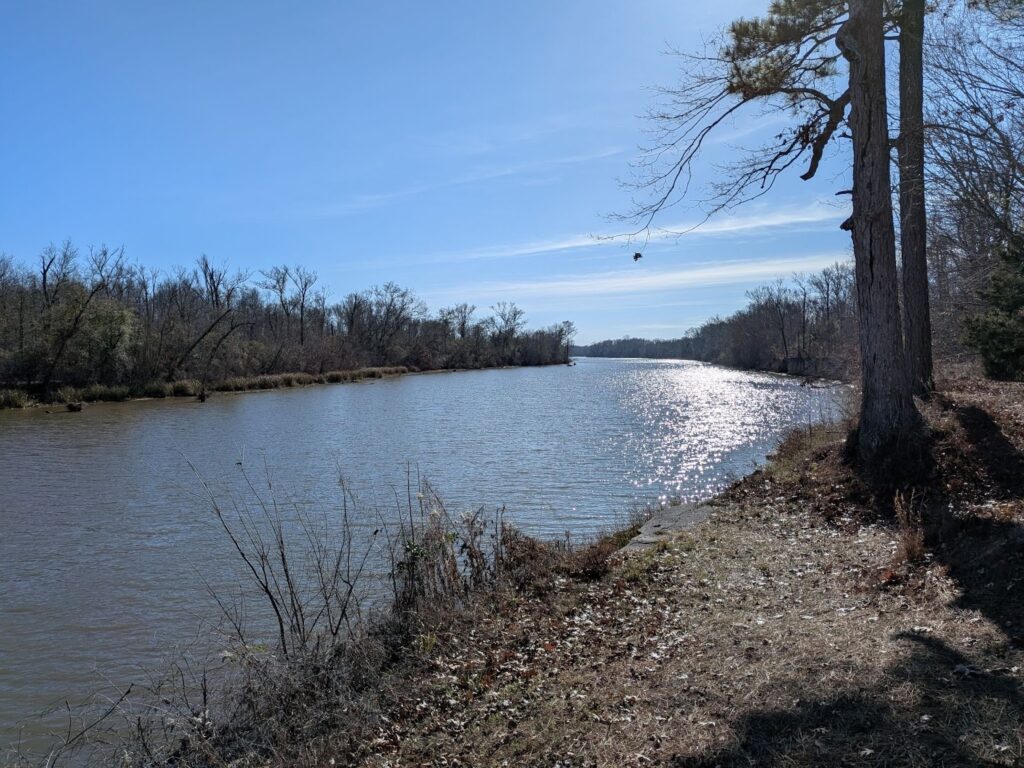
Photo of the Pearl River, as seen from River Bend Park along the Natchez Trace in Canton, MS. Photo by the Author. 

Recent Fascinations | The Fiction Books that Made Me #7: CHRISTINE

Want to understand what this series is? Go Here 

“Come on, big guy. Let’s go for a ride. Let’s cruise.”

I had some hesitation on putting two King novels back to back on this list. Eventually, though, I decided that CHRISTINE couldn’t be left off. While other books eventually surpassed it in their importance to me or my own personal enjoyment of them (this book is only number seven, after all), there is an argument that CHRISTINE is responsible for a great deal of my love for writing and reading. In order to explain why, though, I’ll have to walk all of you through a little biographical aside. Bear with me, I promise it’s going somewhere and it should be interesting. At least, I hope it is. 

Throughout my adolescence I spent a lot of time at my paternal grandparent’s house. Both my grandfather and grandmother were big movie and TV people, and a lot of my love for both mediums came from them. However, there was a particularly special happenstance that would come around every once in a while. Occasionally, my dad and I would end up over at their house with just my Grandpa, and for whatever reason we often ended up watching at least some significant stretch of TV together. Often it was some outdoors show, a fishing or hunting TV show, but every once in a while it would be a movie that we caught on local cable. Most of the time, the movie was a western, but every once in a while we ended up watching something that seemed a little out of place. At least, out of place in the context of a decidedly rural and generally conservative household. 

One time, when I was around 10 years old, that movie was the 1983 adaptation of CHRISTINE. 

Now, to an outsider looking in, this probably feels a little out of left field. However, I PROMISE it wasn’t. There is a long tradition of Hot Rodding and Southeastern car culture that my grandpa passed on to my dad and my dad passed on to me, and that day watching CHRISTINE was a big piece of it. My dad, if I’m remembering right, had seen the movie in the 80s, and my grandpa never had. Obviously, I never had either, but that long and furious (ha ha) Plymouth caught my attention and we ended up watching it. 

Now, there’s a couple things I need to get out in the open. Was I too young to watch the Christine movie at 10 years old? Probably. Did it scare me? Not really, the car was evil but not particularly scary. Did it have a huge impact on me as a kid? Oh yes. Not only did it help cement me as a car guy, but it also made me a horror fan. It showed me that Horror wasn’t just scary, it was badass and subversive. To a 10 year old redneck there’s little in life more important than the badass to subversive matrix. 

Fast forward a couple years, and the dual combination of my dad’s love for Louis Lamour and my discovery of Stephen King in the school library (THE REGULATORS was my first of his novels, if you haven’t read the first entry of this series) had cemented me as a huge fan of both. Before long, I began ripping through King novels and Lamour westerns as fast as I could get my hands on them. Many of those westerns were my Dad’s, and he bought most of them at Flea Markets (a love for which he got from his mom and passed down to me, I’ll add). One day, I don’t remember exactly the year but I know I would’ve been around 13, he found a mass market paperback of CHRISTINE in a pile of books he was digging through. Somehow, I hadn’t managed to read it yet, despite loving the movie and having become a big fan of King. He handed it to me and, well…

I think it’s safe to say I’ve shown it some love over the years. 

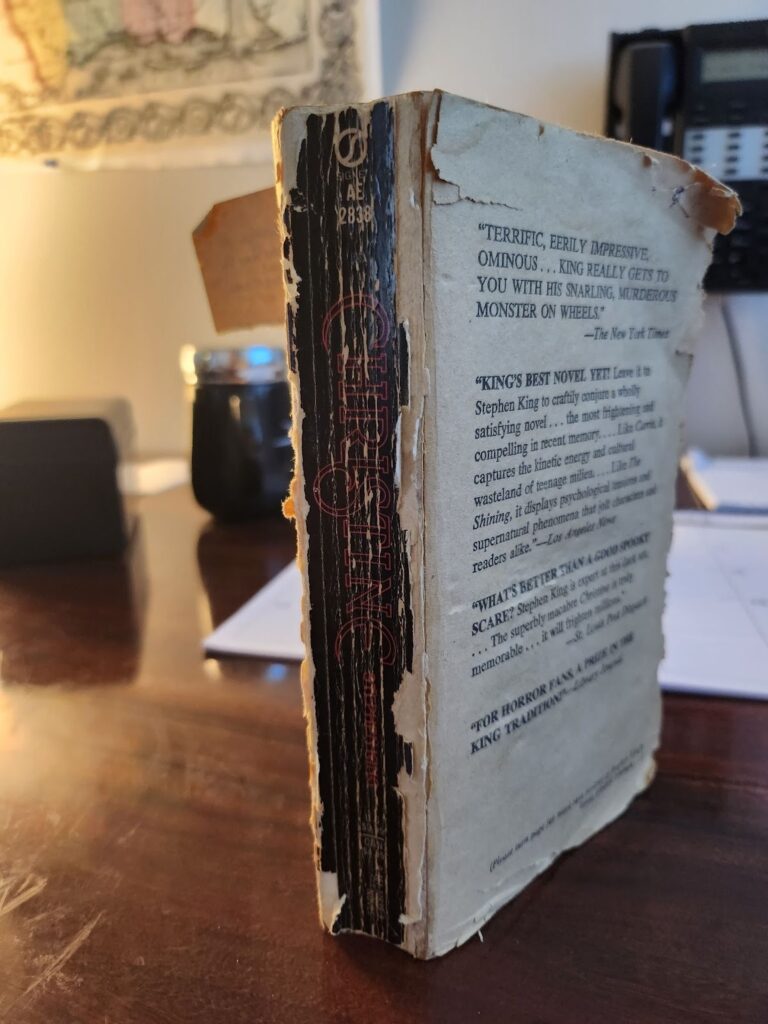
I carried that book around in my backpack for years, including my freshman year of college. I’ve read it more than any other King novel, which means I’ve read it more than any other novel on this list. I won’t say it’s perfect (it’s not) or even King’s greatest work (it’s not), but it holds a really important place in my heart. I’ve since bought a new copy, but this one sits on one of my shelves in my day job office. Had my dad not handed me that copy standing in some dusty flea market, it’s likely I would have gotten to it eventually, but who knows. It might’ve been years later, it might not’ve been as formative. It might not have ridden in my backpack for years, might not have become some part of me in the way that only the most cherished books do. I might not have become so deeply in love with the pulpier, more subversive for subversive’s sake side of horror. I doubt my dad remembers any of this, but it’s those throw away moments that often linger with us the most. 

As far as the book itself, I don’t have a lot to say. It’s less the content of the story, which is excellent, and more the story of how I came to love it that matters in the context of the series. I will say one thing: CHRISTINE is often cited as one of King’s weaker works, and to those people I say: Chill out. Let’s just take a cruise in an old Plymouth Fury and see where it takes us.

Thanks for reading. 

css.php