
Thanks for Reading!
Any support, even just giving these posts a read, is always appreciated.
Still want to grab my book BEYOND THE RUINED NIGHTS?
Get the Ebook here: Campfire
Get Paperback and Hardback here: Bookshop.org
Recent Updates:
Still planning out my Summer Events.
To stay up to date, follow me on Facebook.
Project Progress:
My Horror Novella Project is back from the editor! I’ll be working on completing the edits and getting it to my final reader after I finish the rough draft of the short story I’m currently working on.
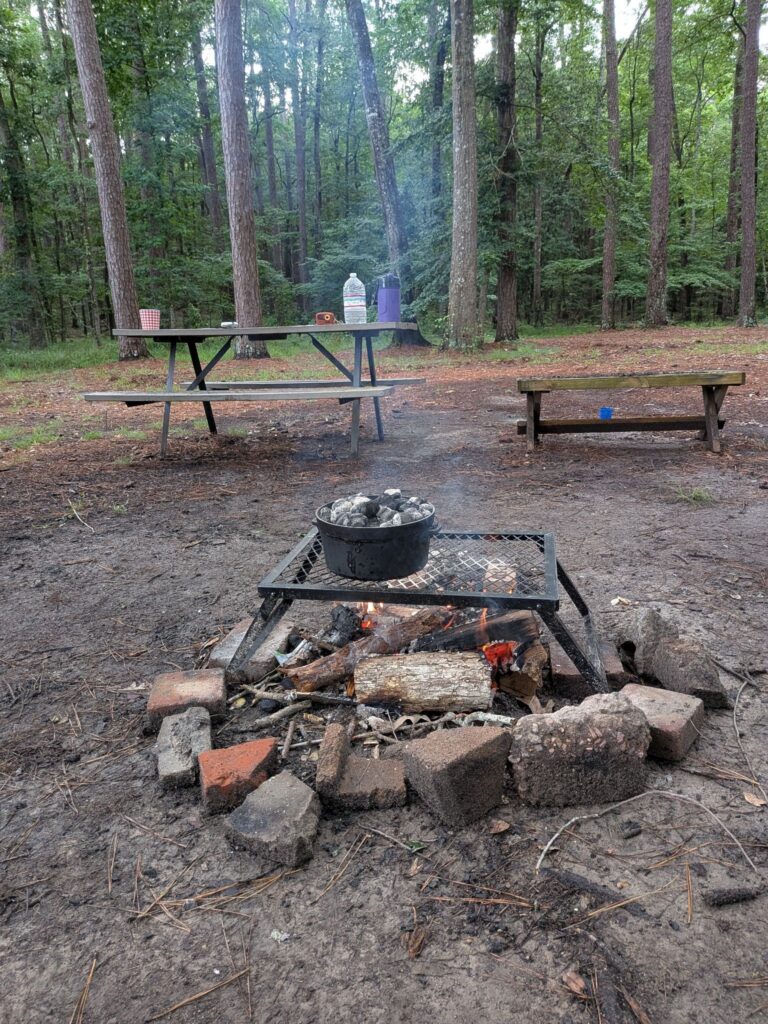
A cast iron dutch oven cooking over a camp fire. Photo by the author.
Recent Fascinations | The Fiction Books that Made Me #2: LONESOME DOVE by Larry McMurtry
“It’s like I told you last night son. The earth is mostly just a boneyard. But pretty in the sunlight, he added”
We have now come to the first of two books which I’m afraid I will struggle to fully communicate their importance. The only place I know to start is in explaining how this book came to be on my list at all. There’s a lot to that, so bear with me.
It is a rare story that impacts us on a personal level, and an even rarer one that fundamentally changes our lives. I think that sort of thing is more common when we are young, high school and those early college years when we are looking for a worldview. It is rarer that one becomes so fundamental to our personal moral ethic late in adulthood. But, this book did that for me.
This is the book on this whole list that I have read most recently, having read it for the first time only two years ago. I had seen the TV miniseries a dozen times over the years, but never gotten around to reading the book. I think, though, I couldn’t have read it at a better time in my life. Had I made this list three or four years ago, there would have been a different book here, one that had lived in this #2 spot for years and years and had been enormously important to me as a writer and as a person.
Neil Gaiman’s AMERICAN GODS.
A few years ago, though, Gaiman (who I would have listed as one of my most beloved writers) was revealed as a decidedly shit person. A (alleged) rapist, a monster. Choose whatever word you most want to associate with him. I’m not saying that this list of writers is free of shit people, Hemingway and Faulkner are two of the most controversial men to ever exist in the space, but my relationship with Gaiman was more complicated than the appreciation I have for Hemingway and Faulkner.. That is not something I intend to unpack here, but it is something I plan to go into in a future newsletter edition.
Regardless of whatever personal hypocrisies might have influenced it, I found myself not able to even look at Gaiman’s books on my shelf after a while. It was at that time, too, that I began to struggle more and more with my mental health, falling into periods of extended depression. And it was then, in that quiet internal storm, that I first read McMurtry’s LONESOME DOVE.
It is hard to explain what exactly makes this story so special to me. Like most fiction, a reader’s reaction to LONESOME DOVE will depend on their own personal opinions, where they are in their life, and what they want out of a novel. For my own personal perception of it, there is a great deal that the novel does that seems on one level or another to speak to me directly. There is the theme of friendship between Call and Gus, a friendship that mimics my own with a close friend and friendly rival. There is also the theme of the two central characters feeling partly responsible for the destruction of a world they loved in pursuit of “civilization.”
“Every bank in Texas ought to pay us a commission for the work we done. If we hadn’t done it, all the bankers would still be back in Georgia, living on poke salad and turnip greens.”
This quote best exemplifies this theme, and it is something that I find myself looking back on a lot. Gus and Call and many other characters in the book almost seem to long for a wilder period of the West they claim existed. This former period was more violent, more dangerous, more perilous, but to hear the characters in McMurtry’s novel tell it, it was better, too. More pure. This idea, the idea of a golden past that slipped by without us realizing it, appeals to me a great deal. It is something I can see myself in, that I have felt myself more than once, and especially in those moments where the world has felt its darkest.
There is, though, another side to this. There is a palpable irony to this romanticized past. A past where Gus lost friends, where he killed countless men. In the end, to spoil the book, it is this romanticization that gets Gus and many of his new friends killed as well. Had they remained complacent, not gone out searching for that old sense of adventure again, then he would have very likely died of old age. But I can’t help but think that Gus would never have been happy with that death. That it was never the longevity of life that mattered to him, but instead the experience of it. “It doesn’t matter where you die,” he says at one point, “but where you live.”
I think at this point it should be obvious that Gus is my favorite character. If I am being honest, it is not even close. Gus’s relationship with the world, a relationship that McMurtry characterizes openly as “Epicurean,” is something that I find a lot of value in. When I first read this book, I was at a low. Gus’s rejection of pretension and open embrace of all things wonderful in life was, and is, deeply appealing. During the periods of my life where I feel like everything is bearing down on me, I often find myself thinking back to my favorite Gus quote.
“It’s a fine world, though rich in hardships at times.”
My God, ain’t that the truth.
It isn’t just Gus and McMurtry’s characters that spoke to me, though. So far, I have talked only about my personal relationship with LONESOME DOVE, but this is a newsletter about writing (supposedly), so I should probably talk some on how the book has impacted me as a writer.
LONESOME DOVE is one of those stories you’ll often hear writers talk about, one that made them question if there was even any point in trying to write at all, considering they could never manage to write anything half as good as what McMurtry managed. This is, of course, ridiculous. LONESOME DOVE isn’t just a Pulitzer winner, it is one of the most beloved works of American fiction ever written, with perhaps the widest appeal of any other Pulitzer winner. I don’t know if I can name any other that went on to become as important to Stephen King as it did truck drivers from south Mississippi and ranch hands in north western Montana.
Even still, though I know that it’s foolish to compare myself to one of the greatest books ever written, how could I not? When a book has such a profound impact on us as writers, it is hard to not hold our own works up against it and wonder if they’ll ever do the same. Again, I know it’s foolish, but at the same time this line of thinking is often unavoidable. Instead of running from it, I’ve tried to find some wisdom within LONESOME DOVE for my own writing, and what I’ve found might be some of the most important writing advice that I’ve come across.
First, McMurtry’s masterpiece has taught me that books written almost entirely about a character’s emotions and perceptions can absolutely work. LONESOME DOVE is a work deeply concerned with the feelings and internal lives of its characters. Call’s brooding at the river. Gus’s pursuit of joy. Jake’s fear of what he’s let himself get into. It is a book that lives and dies by the internal world of its characters. My own work, especially THE SONG OF CALARINE, treads similar ground. Sarah’s internal world, her anxieties and failures, are the primary thing I am trying to explore in these stories. I am, of course, not saying that I approach even a smidge of what McMurtry did, but only that LONESOME DOVE has served as a guiding light on how to write this kind of story and write it well.
The second, though, is perhaps the most important.
They ain’t all winners.
McMurtry certainly has other books that are brilliant, but of the ones I’ve read, PRETTY BOY FLOYD and the LONESOME DOVE sequel STREETS OF LAREDO, they’ve ranged from passable to actively upsetting.
I don’t say all of this to make light of McMurtry’s achievements, he was a master of his craft and there is a legitimate argument to be made that LONESOME DOVE is the greatest work of American literature ever written. Instead, I’m trying to say that I find the same comfort in McMurtry that I do in Stephen King. That yes, they have both written masterpieces that at times make me question why I even try, but they’ve also both written some real duds.
At the end of the day, I think the most important thing to take away from LONESOME DOVE comes near its early moments.
“If you want one thing too much it’s likely to be a disappointment. The healthy way is to learn to like the everyday things, like soft beds and buttermilk…”
Thanks for Reading.
