
Thanks for Reading!
Any support, even just giving these posts a read, is always appreciated.
Still want to grab my book BEYOND THE RUINED NIGHTS?
Get the Ebook here: Campfire
Get Paperback and Hardback here: Bookshop.org
Recent Updates:
My summer events are set!
July 25th @ The Author Shoppe in Hattiesburg, MS
July 26th @ Magnolia TCG Exchange in Pearl, MS
September 5th @ Pearl Public Library in Pearl, MS.
To stay up to date, follow me on Facebook.
Project Progress:
I am still working on finishing up this short story draft, after which I will shift over to working on prepping the final read version of my horror novella. All other projects are currently on hold until I get these two hammered out.
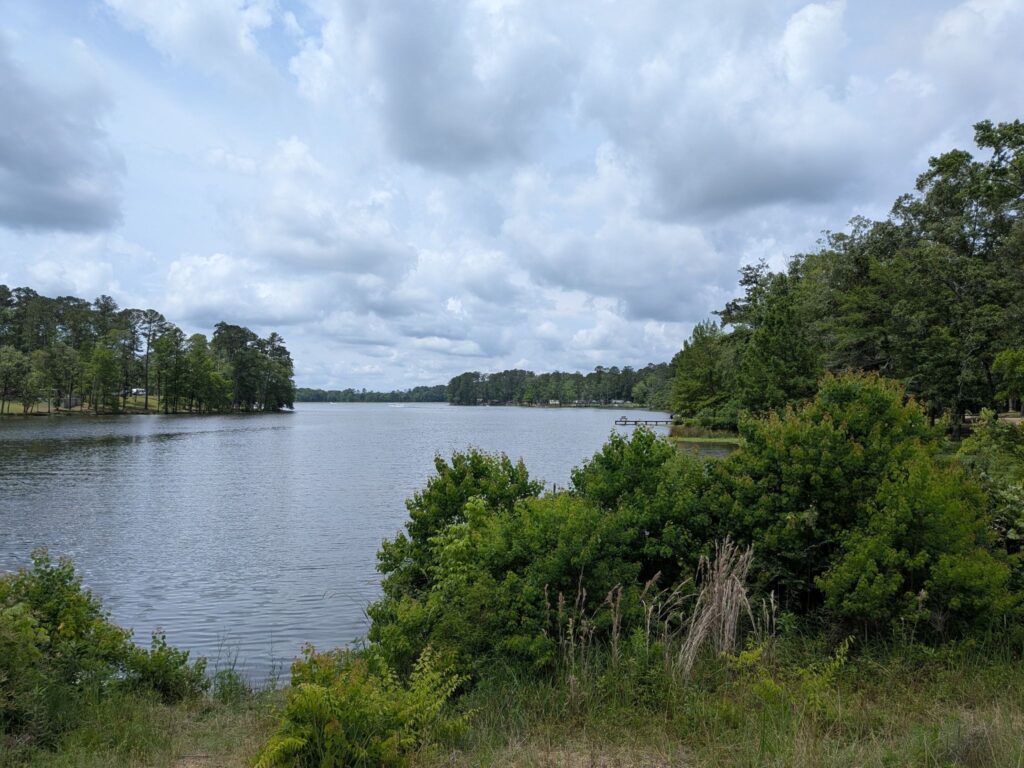
Shadow Lake at Roosevelt State Park, photo by Author.
Recent Fascinations | The Fiction Books that Made Me #1: TO KILL A MOCKINGBIRD by Harper Lee
Want to understand what this series is? Go Here
“The one thing that doesn’t abide by majority rule is a person’s conscience.”
And here we come to the end of the long road, to the story that I have, in a lot of ways, dreaded writing about. There is something in talking about my favorite novel, my favorite story, that fills me with a kind of thin anxiety. As I have prepared to write this, I have struggled with a series of questions cycling in my mind.
“Can I do it justice?”
“Am I qualified to even talk about it?”
“What more can I say about a story that’s been talked about so much?”
Now that I’m finally here, sitting down to write out my thoughts about a story that means so much to me, I am afraid I don’t have any answers to those questions. I am not going to try and do it justice, I’m not going to try to lean on some ambiguous definition of qualification, and I am not going to try and find new things to say about this story. Any work of analysis on a book as important as TO KILL A MOCKINGBIRD is going to be derivative in one way or another. So, I’m not going to try and offer analysis, but instead I’m going to stick to my original purpose for this series of essays. I’m going to explain what this story means to me as a reader and a writer.
Maybe, if I do my job here, I’ll find something more to say as well.
TO KILL A MOCKINGBIRD as It Lives in My Heart
To tell the story simply, I was not a good student as a high schooler.
That might be underselling it a bit, and I’m sure any of my high school teachers reading this would scoff to themselves, maybe even remarking that a more obvious statement could not have been made. I can’t give a reason for why I didn’t put any real effort in during those years. I’ve attempted to make excuses over the years, but they don’t feel earnest anymore. There is no real reason besides laziness or a lack of respect, two things that I have, mostly, grown out of.
That lack of dedication, though, has to be my framework here, because it makes the start of my relationship with Harper Lee’s TO KILL A MOCKINGBIRD all the more important. I had a lot of great teachers during my time at my little podunk high school, but one thing I would criticize them all for was the decision (which was popular at struggling districts in Mississippi at the time) to often eschew reading in favor of watching. We rarely read books in the major English courses, and instead we watched adaptations of them in one form or another. I experienced THE OUTSIDERS, BEOWULF, and ROMEO AND JULIET all through this lens.
Which makes my 11th grade English teacher’s decision to have us read Mockingbird all the more important. There is a gravitas to a book being a reader’s favorite, but that feeling of insurmountable importance is only magnified if it’s a book they read when they were 16 years old. At the time, my scope of personal experience was deeply narrow. I grew up in a town deep within rural Mississippi so small it barely even registers as a town. There is a lot of that upbringing I will forever be grateful for, but my narrow horizons as a young man is not one of them. I was prejudiced, spiteful, insular. I was a great many things then I try not to be now.
For anyone who has grown up in that kind of environment, with that kind of experience, there is often a single moment that begins the long process of shifting their perspective. For me, even if I didn’t realize it at the time, TO KILL A MOCKINGBIRD is that moment. It is hard now, 15 years divorced from the person I was at 16, to find exactly what it was in the book that caused me to turn a critical eye to my view of the world. When I do look back on what struck me so much about that book then, what comes to mind is interesting. I don’t think most of the racial tensions present in every page, or of Boo Radley and his representation of how small towns so easily cast away those that are different. Instead, what stands tallest in my mind is Atticus Finch himself.
More specifically, I guess, what struck me was the way Scout sees her father, which really could be summed up as the entire damn point of the book. Atticus Finch is a mountain of a man, so counter to the depictions of masculinity I had grown up exposed to in John Wayne and his contemporaries. Finch is the ideal father, stern and no nonsense while parenting with a kind of casual grace. He is the ideal Southern man, stoic and strong with an uncompromising sense of morals. Beneath both of these facets of his personality, though, is a softness. He is gentle and understanding to those around him. He moves through the world with an endless supply of grace and patience. He forgives immediately, holding no grudges or judgements against those around him. He loves his children and his community with a brazen forwardness that, at times, feels transgressive.
When Scout remarks on one character’s unexpected niceness, Atticus responds “Most people are, Scout, when you finally see them.”
When I read this book, I had already begun to develop an uncompromising, cynical view of the world that would become the defining feature of my young adulthood. People beyond me and my loved ones were dolts, unworthy of grace or forgiveness. The world was a bleak place that served as an obstacle between me and my own goals, and as such I should respond only to the challenges it offered me with hostility. Unfortunately, my exposure to TO KILL A MOCKINGBIRD did not correct this course entirely. Atticus Finch’s gentle masculinity did not inoculate me to the bigotry and cynicism that characterized my late teens and early 20s. What it did do, though, is plant a seed. Throughout everything, I still upheld Finch as the ideal man, the perfect father, even if I failed to see how I was not living up to those ideals.
This is not the point where I tell you that I have begun to live up to my idealized version of Atticus Finch, either. I certainly try, but I’m imperfect as any person. Quick to anger, too eager to hate. I’m still working to be a better person, but now I think that the real lesson of TO KILL A MOCKINGBIRD for me has become something a little different than just an ideal to strive for. As I continue to step into my 30s, I instead keep thinking back to Atticus and his declaration that most people are good. I hope to find the time to better love my neighbor, to view the world less with cynicism and expectations of the worst, but instead with grace and kindness, even for those who seem like they deserve none.
TO KILL A MOCKINBIRD as it Lives in My Mind
After all of that, it is hard to transition to this. My relationship with TO KILL A MOCKINGBIRD as a reader is as a person engaging with a literary work that touched me during a foundational moment in my life. My engagement with it as a writer is decidedly different. You might think that as my favorite novel, as the fiction book at the top of my list of books that influenced me the most, this book must have had an enormous impact on my work. That is not really the case.
To explain what I mean, I need to make clear exactly how I regard TO KILL A MOCKINGBIRD as a writer.
In 1960 when Harper Lee published TO KILL A MOCKINGBIRD, she published a perfect novel. I mean that as literally as you can take it. There is no word out of place, no scene that feels sluggish or mechanically unsound. There is no edit or change or tweak that could improve the story without harming its greater whole. The thematic depth is endless, the clarity at which it is delivered is astounding. Lee’s novel is, under any metric worth using, literally flawless. While not stylistically divergent in any significant way, TO KILL A MOCKINGBIRD stands shoulder to shoulder with prominent art novels like THE SOUND AND THE FURY and BLOOD MERIDIAN. While an individual reader might not be struck by it in the same way I have been, that is a matter of taste and preference and not a reflection of its flawless nature. It is a novel without any mechanical or artistic impurities, a generational work of art that could never have been replicated. So perfect, in fact, that Lee never published another novel in her lifetime (GO SET A WATCHMAN is a topic for another day). She got it right the first time, and never attempted to dip back into that same well again.
It is that perfection, though, that causes me to set my appreciation for the novel aside when I am writing. Despite my love for it, I do not possess the naivete to think that I am the kind of writer who should attempt to go to that well in Lee’s stead. As I said, TO KILL A MOCKINGBIRD is a perfect work of literary art.
And I am not a literary fiction writer.
I am by every measure a decidedly commercial writer. While yes, I do try and create a work of art with each of my stories, I am not writing from the standpoint of creating some perfect tapestry of artistic expression. Instead, I am attempting to tell a story, hopefully well, that might entice people to read my work. I do, like every writer, take pieces of the stories that inspire me and weave them into my work, but I can say that I do not do that with TO KILL A MOCKINGBIRD, at least not consciously. While there may be some stylistic flourish or some thematic parallelism between Mockingbird and some of my work, it isn’t there on purpose should it exist at all. My relationship with the book as a reader is one of love and thankfulness. My relationship with the book as a writer is one of distant respect and admiration. I know that it lies so far beyond my own work that it is best to set it aside and not try and go to whatever mythical well of genius Lee found herself tapped into during her writing years.
As a writer, it is often just as important to know when to set a work aside, pulling joy from it, but not inspiration.
Still though, on my darkest days when I feel the most imbittered, the most frustrated with the world, it will always be Lee’s words that ring the truest to me. It will always be Atticus Finch that I go back to, that I try to find some wisdom in.
I just hope that one day I might finally see the world with the grace that he could offer.
Thanks for reading.
