
Thanks for Reading!
Any support, even just giving these posts a read, is always appreciated.
Recent Updates:
I have several signings coming up between now and April. If you’re local and want to come out, be sure to check out my Facebook for updates.
Last month, I released a new short story titled “Degeneration”, and you can read it here.
Still want to grab my book BEYOND THE RUINED NIGHTS?
Get the Ebook here: Campfire
Get Paperback and Hardback here: Bookshop.org
Project Progress:
Still waiting on Beta Feedback for my Horror Novella. Will keep you updated on its progress, but I’ve set a tentative goal of having it out by October of this year. We’ll see how that goes.
I am about 20% through the first round of edits for book 2 of Song of Calarine. Slow but steady.
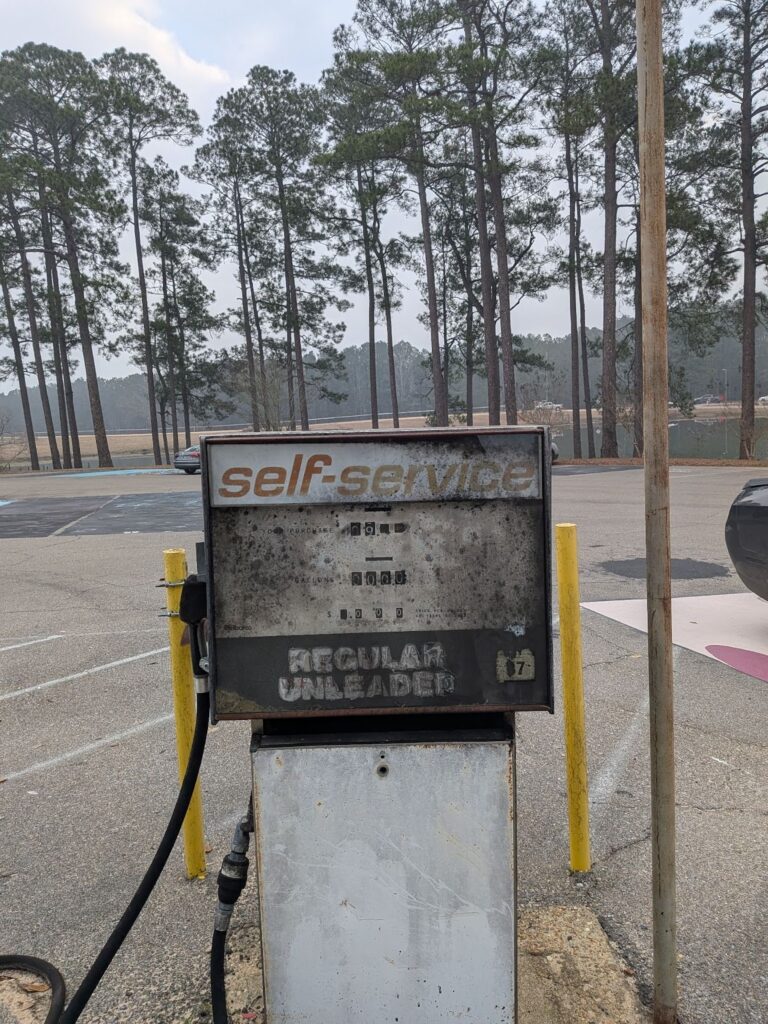
Photograph of the bus fuel pump at historic Forrest County Agricultural High School. Photo By Author
Recent Fascinations | The Fiction Books that Made Me #5: The Sound and the Fury by William Faulkner
Want to understand what this series is? Go Here
“Some days in late August at home are like this, the air thin and eager like this, with something in it sad and nostalgic and familiar…”
This is a difficult book to talk about, in no small part because of the way I have structured the previous entries in this series.
I can’t in good conscience claim that Faulkner has inspired any real piece of my writing. Sure, just as any Mississippian trying their hand at fiction, his textured discussion of our state carries some degree of inspiration for me, but there are a couple of people (Hi, Ethan), who would rightfully call me a liar if I claimed my writing was meant to be Faulknerian.
That hasn’t always been the case. Like any Mississippi writer with too much education, I did at one point try to copy Faulkner’s style. The original version of my story “Father, or the Pain that Lingers” was written nonchronologically and with a little too much heavy handed stream of consciousness. Some of that remained, like the date stamps and one character’s unravelling point of view, but by the time I edited that story and it was accepted into a litmag, it had turned into something more my own.
Despite all of this, THE SOUND AND THE FURY is still one of my favorite novels, and I often find myself thinking on it more and more when working on characters for any of my stories. Faulkner’s characters breathe and behave like real people filled with flaws and trauma, and I have at times attempted to bring some of that same feeling into my own writing, though I will admit such attempts have come with varying levels of success.
As writers, there is a lot for all of us to learn in the books we read, even the ones we don’t pull from whole cloth. There is perhaps even more to learn in the ones we really don’t pull from at all. While I don’t consider myself to be a Faulknerian writer, and in fact actively try to avoid some of those tendencies in my more genre-focused works, I do find his work to be important to me on several levels.
What Faulkner does better than anyone else is depict the real world as humans emotionally experience it. Faulkner’s worlds are not realistic in the purest sense. They are filled with melodrama and plot contrivances, but what makes his work so important is the way his characters interact with the world around them feels painfully real. Quintin Compson is perhaps the quintessential example of this. He is depressed and despondent over being sent to a “yankee school.” He pines for his cousin. He aches for a South that never really was. He, perhaps more than anything, shrinks under the shadow of all the Compsons who came before him. Taken quote for quote, Quintin feels ridiculous in a kind of soap opera way, but when taken in context of the world found in THE SOUND AND THE FURY, how else could he have turned out?
The quote most often recited from Faulkner is “To understand the world, you must first understand Mississippi.” Often, it’s used to try and center Mississippi on the global stage or make our humble little state’s importance seem somehow broader and grander than it is. It seems to me, though, that just as valid a reading of that quotes comes from Faulkner’s own writings. That in order to understand the beyond, we must understand the within.
How could Quintin ever be anything but a Compson?
In the same vein, how could I ever be anything but a Mississippian.
Thanks for reading.
