
Thanks for Reading!
Any support, even just giving these posts a read, is always appreciated.
Recent Updates:
My debut Southern Dark Fantasy novel BEYOND THE RUINED NIGHTS is officially OUT!
It’s available literally everywhere books are sold. Want my recs?
Get the Ebook here: Campfire
Get Paperback and Hardback here: Bookshop.org
Can’t afford to buy a copy? I’m happy to announce that my book is also available on HOOPLA through your local public library!
I recently updated my website to highlight my short fiction, and have begun releasing previously unreleased stories there! Head on over!
Project Progress:
I am so excited to announce that I’ve FINISHED the rough draft of book 2!
I’m setting it aside to let it “cure” for a while. In the meantime, I’m working on releasing some short stories and editing my Horror novel to get it ready for beta readers.
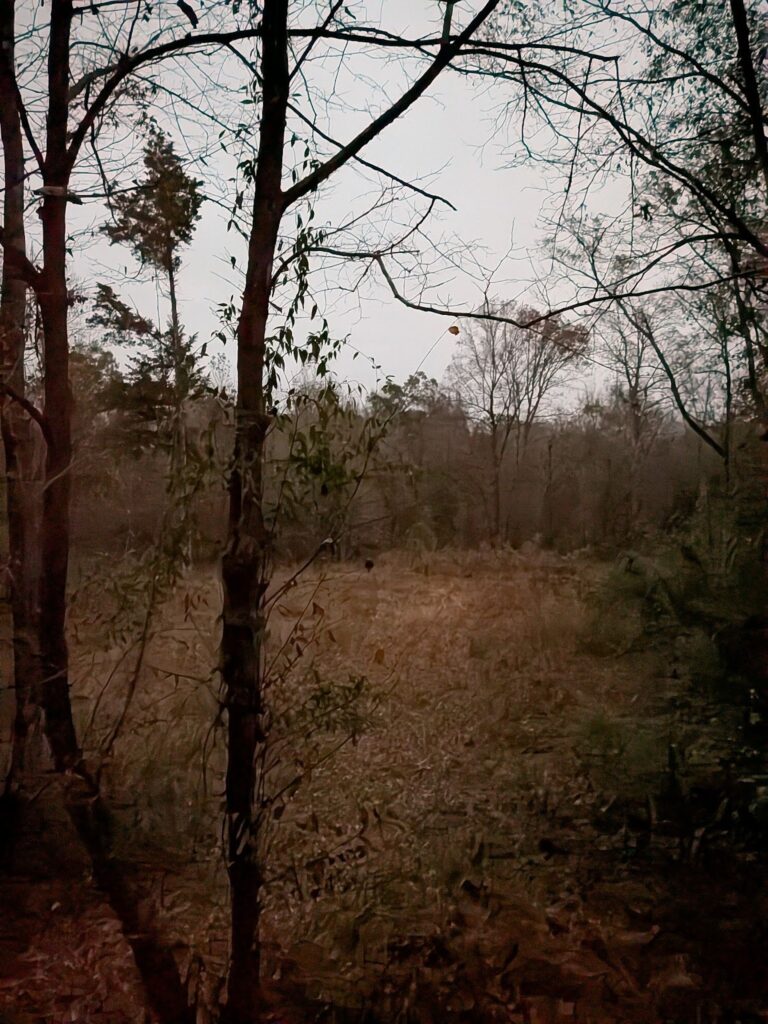
Photo of the Mississippi Delta Hardwood Forests, as seen from a tree stand, distorted by the low light conditions of the early morning.
Photo by author.
Recent Fascinations | The Fiction Books that Made Me #8: IT
Want to understand what this series is? Go Here
“What can be done when you’re eleven can often never be done again.”
It would appear I’m back on my Stephen King shit again already. I do not apologize. This particular King novel is one of his most well known and, depending on who you ask, most infamous.
There is an interesting phenomenon with King novels that, before I get into exactly how this novel impacted my own life, I want to talk through. As of writing, King has published north of 70 books. Most of them a lay person has never heard of and, most likely, never will. A great number of his stories have been adapted into movies and TV shows, but even then people either don’t realize the adaptations originated as King stories. Often when one of his stories bucks this trend, it is one of his more palatable novels. THE SHINING is probably the best example, though the movie doesn’t really adapt the story at all. CARRIE would be another, with that particular story having many, many different adaptations.
Occasionally, though, one of his…weirder stories breaks containment and becomes part of the popular consciousness. CHRISTINE had no reason to get as good of a movie as it did. THE STAND has been adapted, poorly, twice. More recently, GERALD’S GAME was adapted, something I never imagined would happen. It’s a weird story, with some weird elements. But by far the story of his that has so thoroughly defied what should make sense for adaptation is 1986’s doorstopper of a dark fantasy/horror/scifi epic IT.
Now, it’s time for me to pull the wool from your eyes. This whole little introduction has actually been to serve a very…selfish purpose. It has given me the best opportunity to say something that will ruffle some feathers without putting it front and center: I hate every adaptation of IT and will not be discussing either version further. Pick a clown, Tim Curry or Bill Skarsgaard, I don’t like either one. We will not be discussing either adaptation again in this little essay.
For me, IT is a novel that defies expectations. People often go into it expecting a straightforward horror novel centered around a killer clown. Certainly, Pennywise is the central antagonist and often takes the form of a flesh-eating clown. To me, though, reducing the book to just this base assertation misses, if you’ll excuse the language, the entire fucking point.
What the text of IT is really trying to do is pretty straightforward. It is a boomer author dismantling his own nostalgic memories of childhood by pulling away the veneer of civility and positivity so often associated with the 1950s. His method just happens to be an extra-dimensional, malevolent entity that feeds on the raw emotional energy produced by fear, and said entity just happens to occasionally take the form of a clown. Pennywise does this, of course, because people are just scared of clowns. Throughout the novel she (yes, Pennywise is a she) also takes the form of a giant Paul Bunyan statue, a werewolf, an extradimensional spider monster, and several other upsetting pastiches of nightmare imagery.
While Pennywise is an excellent villain, it isn’t really her that I care about. At least, not as far as IT relates to me and my writing. I can vividly remember the first time I finished reading the novel. It was probably a decade ago. My now wife and I were staying with my parents at Lake Washington in the Delta, and I sped through that beast of a novel over the course of a long weekend. I remember the feeling it left me with wasn’t one of dread, but instead a feeling of abstract introspection. The way King deconstructed his childhood and took a look at the things we most often feel nostalgia for, childhood friendship, our hometowns, deeply affected me.
None of my writing, thus far, has been focused on deconstructing the nostalgia of my own childhood, but all of it, in one way or another, has attempted to deconstruct what I perceive as the reality of my home state. IT didn’t just show me that doing so was possible, it showed me that the key to doing it well was keeping your characters as human as possible. They need to live and breathe, even if they are irredeemable monsters or foolish kids.
As my writing has progressed, my style has diverged further and further from that of King. While he still remains a huge inspiration, I don’t spend most of my time attempting to mimic his storytelling style. However, in those earliest foundational moments, his entire catalog contributed to different pieces of my writing. IT taught me, perhaps more than any other novel before or since, that in order to tell a good story, we have to turn our attentions inward.
And, sometimes, a scary clown is more than just a scary clown.
Thanks for reading.
