
This work of Creative Nonfiction was Originally Featured as a Quick Dispatch in my Zine Series. Read the full Zine here.
I can’t remember my fourth-grade science teacher’s name, but I remember something she taught me.
It was fall, I’m sure, because I don’t remember it being hot. It was one of the rare moments we got to go outside. By that point I was already starting to wane as a student, so going outside was a big deal. It was a reprieve.
We were learning about trees that day, and she led us around my tiny school’s campus, teaching us to identify native trees. I still remember most of the lessons learned that day. The entire thing instilled in me the intrinsic value of trees, of their complex structure and their purpose in our lives. And then, lunch nearing and our time running out, she stopped beneath a towering pine tree at the back of campus near the baseball field.
It was a true longleaf, she said, once the dominant type of pine in the region that had been logged almost to extinction at some point in the 1800s. She said that it was more than 100 years old, and it looked it. It was massive compared to the other scraggly pines that I had grown up seeing. It had no limbs until halfway up its length, and it towered over the school. Near the base where we stood, it was almost four feet across.
She asked for a show of hands of everyone in the class who had a parent who had attended the same school, and of course, everyone raised their hand. She told us that this tree had seen our parents as they went to school, that it had seen children and teachers and workers all come and go from our school for as long as it had existed, that the tree was here when they first built the old Presbyterian Seminary that gave our town its name. She called it a “Witness Tree”, and explained that it was the last remnant of the town’s true natural history.
I remember, ten years old and looking up at the thing, that I felt emotionally struck by this, even though I didn’t understand why. This tree, so many of its kind cut down to build the homes and businesses that made up my little town, had lived through it all. It had seen children come and rest nearby. It had watched as those same children had gone to war, many never coming back. It had watched my mother and her siblings. It watched me, still.
Another kid scoffed; I remember that too, and said that it was just a tree. No, the teacher had said. It’s so much more. It’s my home, and it’s yours too.
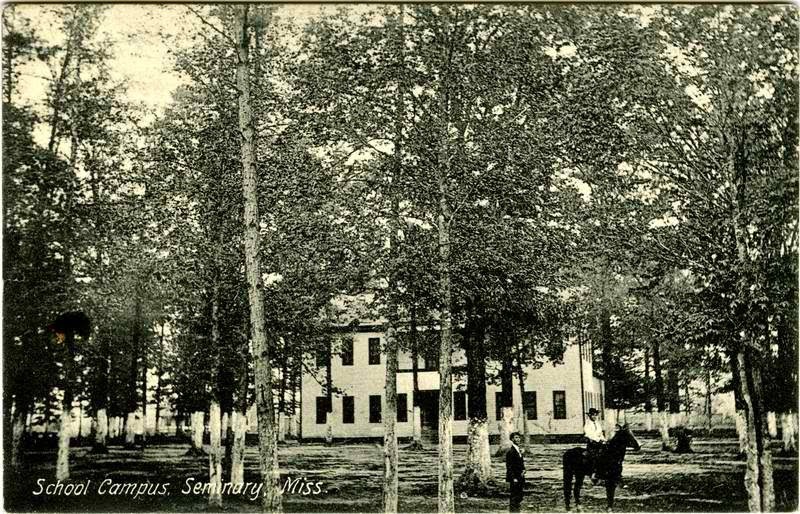
I didn’t become a botanist because of this experience, but I did become a historian. That probably makes more sense anyway, because it was never the stature or the mechanics of the tree that struck me, but the things it had seen. Some years later I found this photograph in a collection about my hometown at the state historic archives. That’s the old school, though which iteration nobody knows. I also am not sure if you can see that old tree there either, but I feel like its spirit is there all the same.
Some decade after that teacher had shown her class the tree that clearly meant a lot to her, the school cut it down. They built a parking lot over it; more room for the baseball field was needed, so they said. Fewer kids attend that school today than when I was ten years old, but yes. The tree had to go, clearly; progress so dictated it. It had survived greed and war and fire. It had been left by the Presbyterian missionaries who had come and settled the town; it had been left in the name of academics and joy and tradition, but it could not survive the wanton progress of public school athletics. What can, though? Certainly not public school academics, so why should I have ever expected something different for the Witness Tree? We need no witnesses of our past in this modern era, only the march of progress.
I wonder if my teacher wept when they cut it down? I certainly did.
Not long after they cut that tree down, they tore the old bandstand in front of the high school down too, the last relic of my grandmother’s time there. Another small thing that represented the past of the school, gone and paved over for a new drop off line. Though, I guess that’s a different story. A different memory.
It’s funny, though. I haven’t lived in Seminary for eight years. I haven’t been on campus at that school in 12. These days, I call a new place home. I am raising my family in a new town with new things and new memories, but my heart still seems to be there. Looking up at the Witness Tree and wondering what it thought of me.
